Atri's cloud was not a "ghost": award to Deda Next, €119,560 settled
An earlier version of this dossier, published on 18 September 2026, claimed that the PNRR cloud funds had been lost, with no supplier and no CIG code. A document published by the Municipality on 2 October 2026 disproves that account: the project had already been awarded in 2024, and almost the entire sum has now been settled. The text has been corrected.
Method: Public Notice Board, PIAO, OpenPNRR
Monitored CUP: B31C23000020006
Updated: 2 October 2026 (corrected)
The facts, in order
The Municipality of Atri obtained €121,992 in PNRR funds (Measure 1.2, "Cloud enablement for local public administrations", CUP B31C23000020006) for the Cloud migration of 14 digital services: civil registry, vital records, military conscription, electoral roll, statistics, access to records and civic access, protocol, public notice board, accounting, procurement, payroll accounting, personnel management, contracts, ordinances.
With determination no. 909 of 30 May 2024, the Municipality awarded the service to the company Deda Next S.r.l. (based in Trento), for the development of a cloud document-management software covering the 14 modules listed above plus three "additional services" (administrative records, attendance tracking, payroll), as well as migration from the data centre, document storage (up to 25 GB), legally compliant archiving (up to 25,000 documents/year), staff training, start-up support and a 12-month maintenance fee. The amount is €98,000 plus 22% VAT, i.e. €119,560, with CIG B1B767BE0E.
With determination no. 975 of 1 October 2026 (published on the Public Notice Board on 2 October 2026), the Municipality settled invoice no. 301600614 of 31 May 2026 from Deda Next S.r.l., for the full amount of €119,560: €98,000 to the company and €21,560 to the Treasury under split payment. The committed funds (no. 2301654) amount to €121,992, i.e. the entire grant: after this settlement, €2,432 remains unspent.
What remains to be clarified
The Municipality's 2025 PIAO (updated as of 31/03/2025) listed the project as "in the contracting phase", with €0 committed — a figure already overtaken by the May 2024 award. Why was the PIAO not updated?
The same PIAO listed the final expected deadline as 16 January 2026: the settlement comes after that, in October 2026. Was an extension granted, and by whom?
The settled invoice is dated 31 May 2026, around two years after the award (May 2024): when did the actual migration of the services take place, and was it tested?
The determination lists 17 modules, while the PNRR application funds 14 services. The first 14 on the list match the application's count; the determination's title mentions "additional services", which may correspond to the last three. Which 14 services exactly are covered by the PNRR funding, and were the remaining ones paid separately?
Has the technical certification (asseverazione) required by the PNRR been carried out?
The first application, withdrawn by renunciation
Before obtaining the €121,992, the Municipality had submitted an identical application for the same 14 services, but for a lower amount.
Application
CUP
Amount
Outcome
First application
B31C22000600006
€ 83,044.00
Revoked by withdrawal
Second application
B31C23000020006
€ 121,992.00
Awarded (2024) and settled (2026)
The Municipality withdrew the first application by renunciation, then reapplied for the same 14 services asking for a higher amount (+46.9%), and obtained it. The records examined so far do not show why the first application was withdrawn: that remains an open question, to be put in writing to the Municipality.
Two suppliers, two separate PNRR projects
The Municipality's new website and citizens' app (Municipium) belong to a different PNRR project (Measure 1.4.1, CUP B31F22003970006), awarded to Maggioli S.p.A. The cloud project described here is a separate one (Measure 1.2, CUP B31C23000020006), awarded to Deda Next S.r.l. They are two different companies, under two different contracts, and should not be confused.
The cloud project concerns the Municipality's IT engine — the servers, the databases, the invisible foundations of the administrative machine — while the website is the citizen-facing side. The actual migration timeline and the outcome of the PNRR technical certification still need to be verified for both projects.
Open questions
The picture that has emerged so far does not close the matter. The questions we put today to the administration, the Mayor, and the Responsible for the Procedure (RUP) are these:
Open questions
Why did the 2025 PIAO not record the May 2024 award?
Was an extension granted beyond the final expected deadline (16 January 2026)? By whom, and under which act?
When did the actual migration of the 14 services take place, and was it tested?
Which 14 of the 17 modules listed in the determination are exactly the ones funded by the PNRR, and were the remaining three paid separately?
Why did the Municipality withdraw the first cloud application worth €83,044?
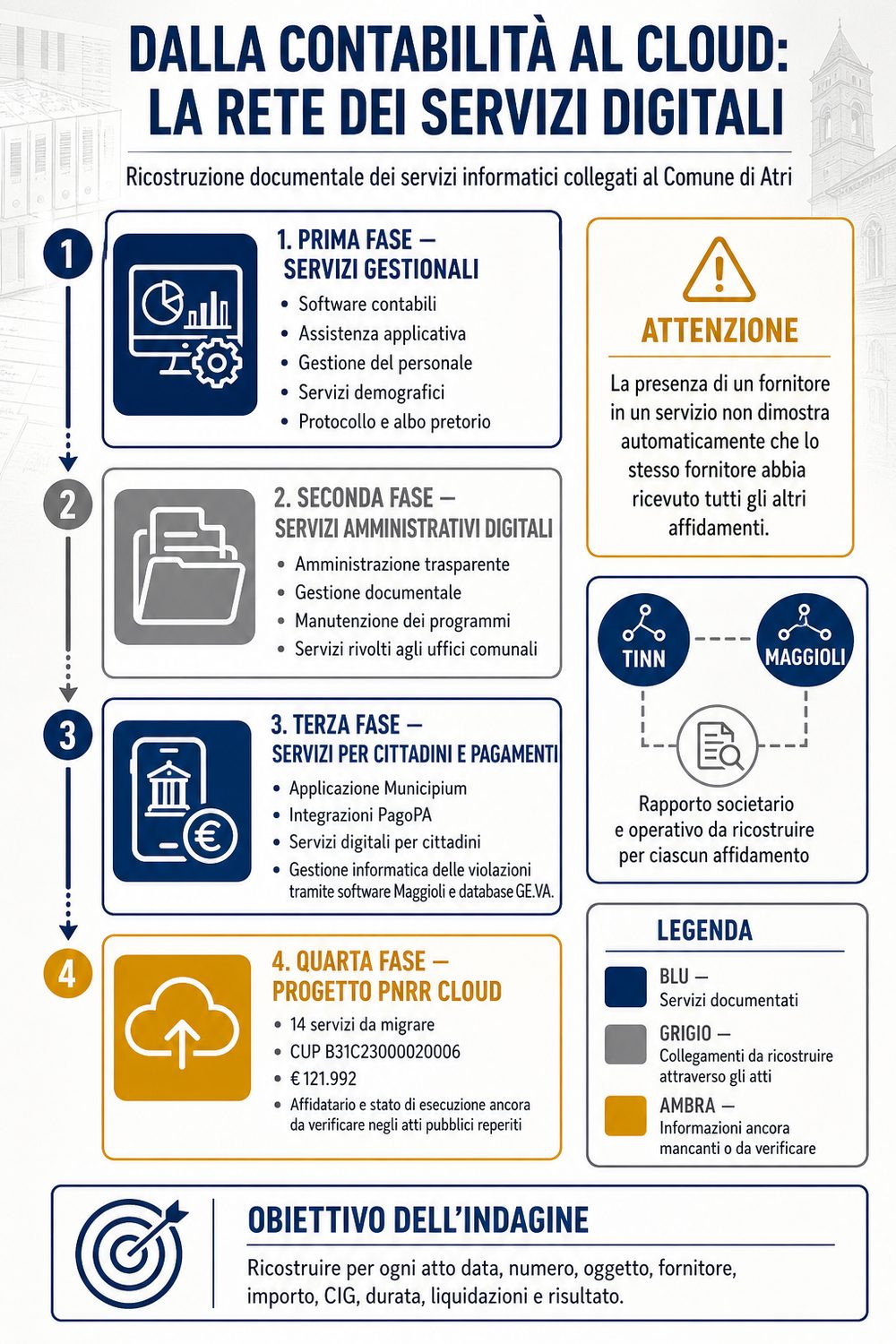
The four phases of Atri's computerisation, and the corporate relationship still to be clarified.
Coming up · The monopoly's red thread
The cloud project turned out differently from how the first version of this dossier told it. But another question about the Municipality's digital systems remains open: who actually runs the Municipality of Atri's IT "brain" today? The roots of this system reach back to the early 2000s, tied to the Teramo-based company TINN S.r.l., now merged into the giant Maggioli S.p.A. (merger by incorporation effective from 1 May 2025).
Locally, some try to play it down, telling the story of two separate, unrelated companies, as if history had simply reset. But the documents, the server-farm services active for over ten years, the handover of the control rooms, and the fierce continuity between the software used in Atri in the 2000s and today's tell another truth. A truth made of a single, unbroken corporate ecosystem spanning a quarter of a century. But who has really held the city's digital keys for over twenty years, what this continuity has really cost, and who was pulling the strings then and now — that is the subject of our next investigation.
 OPENCIVTECH