Verifiable Administrative Investigation
The gym that isn't there anymore.
From the Bargiglione's collapse to the open-air field: fourteen years of projects and funding without ever giving the pupils back a covered gym.
 OPENCIVTECH
Atri outpost
OPENCIVTECH
Atri outpost
From the Bargiglione's collapse to the open-air field: fourteen years of projects and funding without ever giving the pupils back a covered gym.
In December 2025 the Municipality of Atri presented the redevelopment of the area behind the Viale Umberto I primary school as nearing completion. Mayor Piergiorgio Ferretti spoke of a new sports space "the size of a regulation school gym" and, in the same statement, announced thirty parking spaces also intended for the historic centre.
The area is paved and marked out, but remains outdoors. The roof is not built because, the Mayor explains, "the available funding was not sufficient": completing the structure will require another grant.
To understand what this result means, we need to go back to what existed on the same site before 2012: not an empty space to be transformed, but the Uliano Bargiglione municipal gym, a covered facility used by primary-school pupils and local sports clubs. In February 2012 part of the roof gave way. The gym was never recovered: it was left exposed to the weather for years and was eventually demolished.
In 2022, ten years after the collapse, the Municipality approved a detailed executive project worth €350,000 to build a new covered sports structure on that very site. Three years later, an open-air field and thirty parking spaces stand there instead. It is this gap — between the gym that existed, the one that could have been saved, the one designed in 2022 and the one delivered in 2025 — that makes retracing the whole story necessary.
The story of the Bargiglione gym does not begin with the February 2012 snowfall. The roof had shown problems at least two years earlier: leaks from the roof had reached the walls and the parquet floor, and the Municipality had carried out waterproofing works.
Eleven days after the collapse was discovered, Roberto Marchione wrote to Mayor Gabriele Astolfi, Public Works councillor Francesco Filiani and Sports councillor Umberto Italiani, asking them to verify:
On 21 February 2012, in the days immediately following the collapse, CityRumors had already reported that the roof had been waterproofed and that the earlier leaks might have caused internal damage, later worsened by the weight of the snow — asking whether it was really possible to blame everything on the snowfall.
This alone does not allow the waterproofing works to be blamed for the collapse: the technical drawings, the works certificates and the original survey would be needed, and are still missing (also missing: the award determination, the contractor, the amount, the site supervision, the description of the works, and any subsequent checks). It is however possible to establish one fact: the roof did not enter the winter of 2012 without prior issues, and had already suffered leaks serious enough to require action by the Municipality.
The failure was discovered on Monday 13 February 2012, described in the first hours as a consequence of the major snow emergency affecting Atri and much of Abruzzo. An initial inspection identified the first entrance beam as the element that had failed, but officials still spoke of the need to ascertain the "real cause of the collapse".
According to the most detailed reconstruction, published in 2015, the exact moment of the collapse was not known: Atri Volley reportedly held its last training session on the evening of Thursday 9 February, finding the structure damaged when they returned on the 13th. The 24 February request also placed the collapse in the window between 10 and 13 February, without a certain day or time.
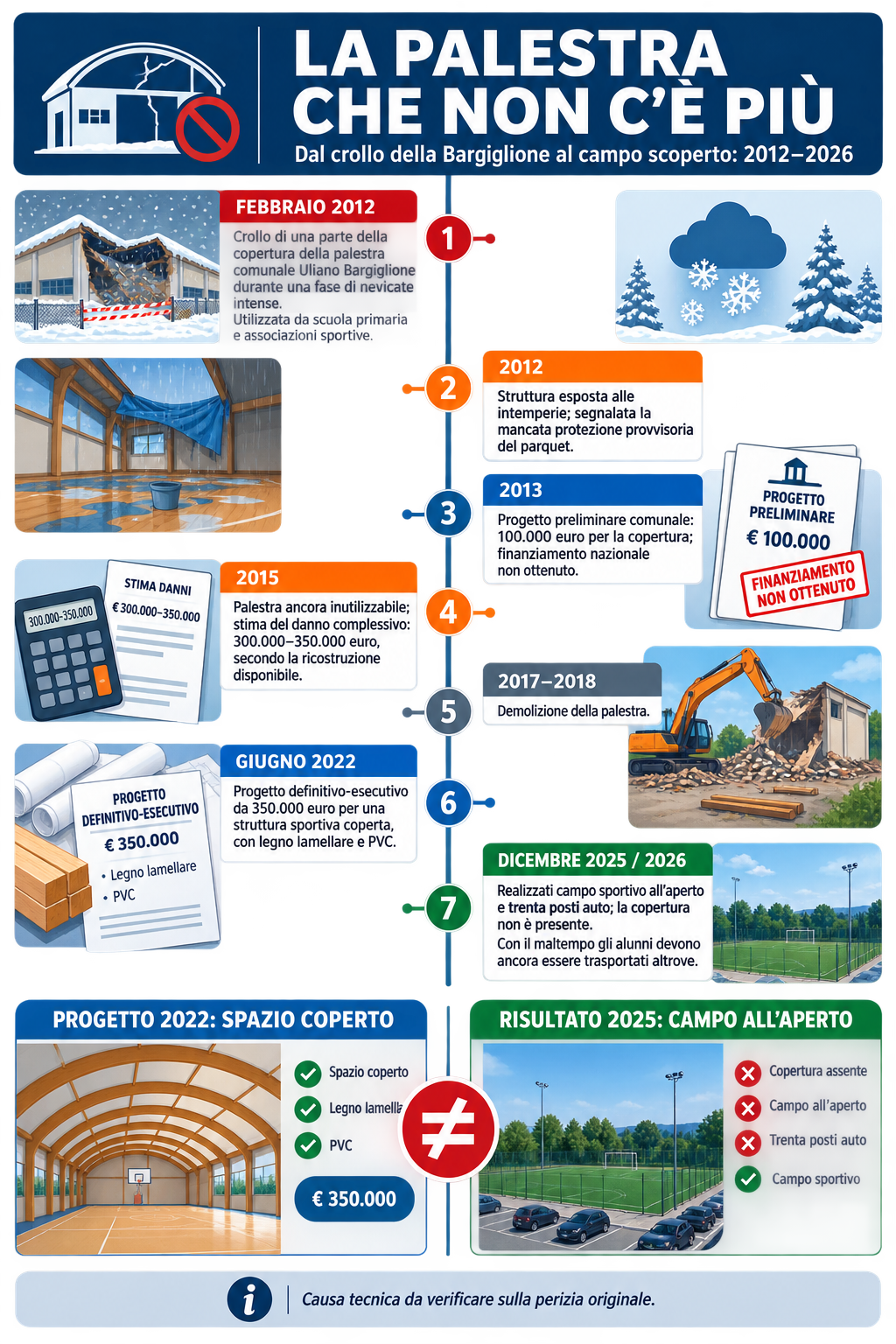
According to the investigation published by Roberto Marchione in 2015, engineer Tito Rocci's survey attributed the collapse to an overload of "particularly wet", and therefore heavier, snow — a condition typical when rain follows snow. The reconstruction noted, however, that this seemed to contradict local memories of continuous snowfall.
This source did not identify a significant rain spell in Atri before the collapse was discovered. This alone does not disprove the survey — not yet available, known only through the 2015 summary — and very heavy snow can increase in density through compaction and refreezing even without an evident rain episode. The accumulations were, in any case, very substantial.
What weather data was used — temperatures, hourly precipitation, the snow's water equivalent, the specific weight assumed, the calculated load — and were the roof's earlier problems and the waterproofing carried out two years before taken into account? According to the 2015 reconstruction, these elements were not mentioned.
While the causes were being debated, the immediate problem was concrete: part of the roof no longer existed, and the parquet, systems and interior were exposed to the weather. The 24 February request asked why at least a temporary cover for the parquet had not been put in place. According to the 2015 reconstruction, in April 2012 councillor Filiani announced that engineer Rocci had been commissioned to assess causes and damage, without mentioning temporary protection; by September a new public report claimed that no remedy had been arranged and that the lack of temporary cover was increasing the deterioration and its cost.
In June 2013, sixteen months after the collapse and with the Rocci survey not yet delivered, the municipal Technical Office had drawn up a preliminary project worth €100,000 for restoring the roof, approved by the City Executive for a national grant call — the application was not successful. (The original resolution has not yet been retrieved: this figure should be attributed to the 2015 press reconstruction until the municipal act can be verified.)
The Rocci report was reportedly delivered around two years after being commissioned. According to the September 2015 account, restoring the roof alone would have cost at least €120,000; the overall damage estimate — including the now-unusable parquet and the systems deteriorated by exposure — rose to between €300,000 and €350,000, not counting any works on changing rooms, stands and emergency exits.
This figure does not show that €120,000 would have sufficed to reopen the gym immediately in 2012: it shows that the cost of the problem tripled while the structure remained uncovered, a substantial part of it tied to the deterioration accumulated over time.
By September 2015 the Bargiglione was still essentially abandoned. In March 2016 the local Democratic Party denounced its condition; in January 2017 a report described a nursery-school wall bordering rubble still present on site. Demolition came during the 2017/2018 school year, permanently closing off any chance of recovering the original structure: from that point the problem changed nature, from repair to designing from scratch.
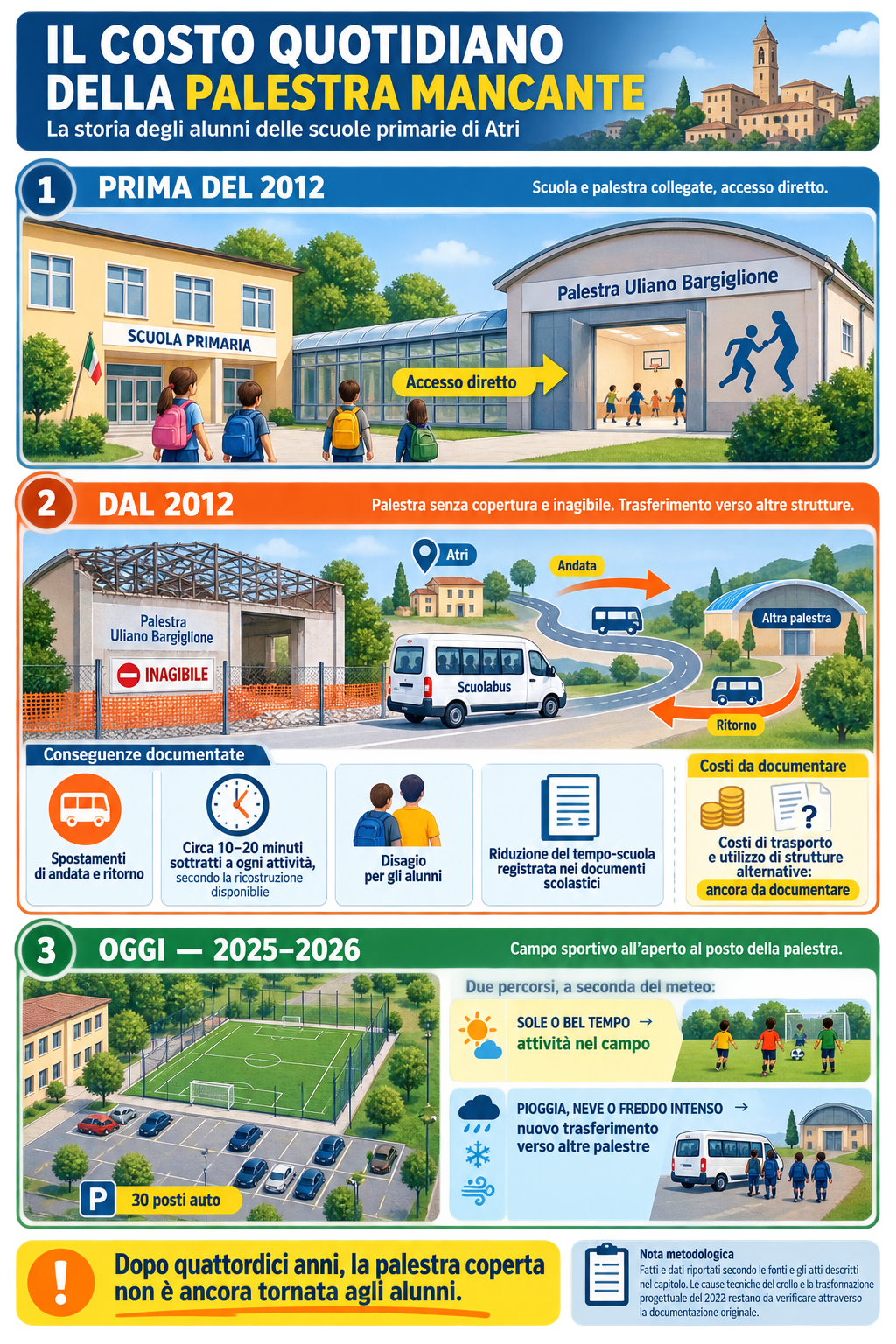
The Bargiglione was not just available to sports clubs: it was the primary school's gym. In 2015 the head teacher explained that physical-education lessons continued, but pupils had to be bussed to the Centro Turistico Integrato, kilometres away — estimating 10-20 minutes lost from each session for the travel. After the demolition, the Istituto Comprensivo's own records officially noted inconvenience for pupils and a reduction in teaching time.
After the demolition, two distinct lines of intervention appeared, to be kept separate as they relate to different funding and programmes. In 2021 a €700,000 project was approved for a new multi-purpose building for the nursery school — broader than simply rebuilding the Bargiglione, and conditional on securing the relevant funding.
The project meant to actually give back a gym followed another line: project CUP B37B20082350005, "safety works on the area behind the primary school" on Viale Umberto I, total funding €350,000. Presented in June 2022 as a response to the missing gym, on 30 June the City Executive approved the detailed executive project; the following day the tender was announced, with works expected to start by the end of September.
The roof was not an optional add-on: it was part of the approved project, with the explicit purpose of allowing use "even in periods of adverse weather conditions".
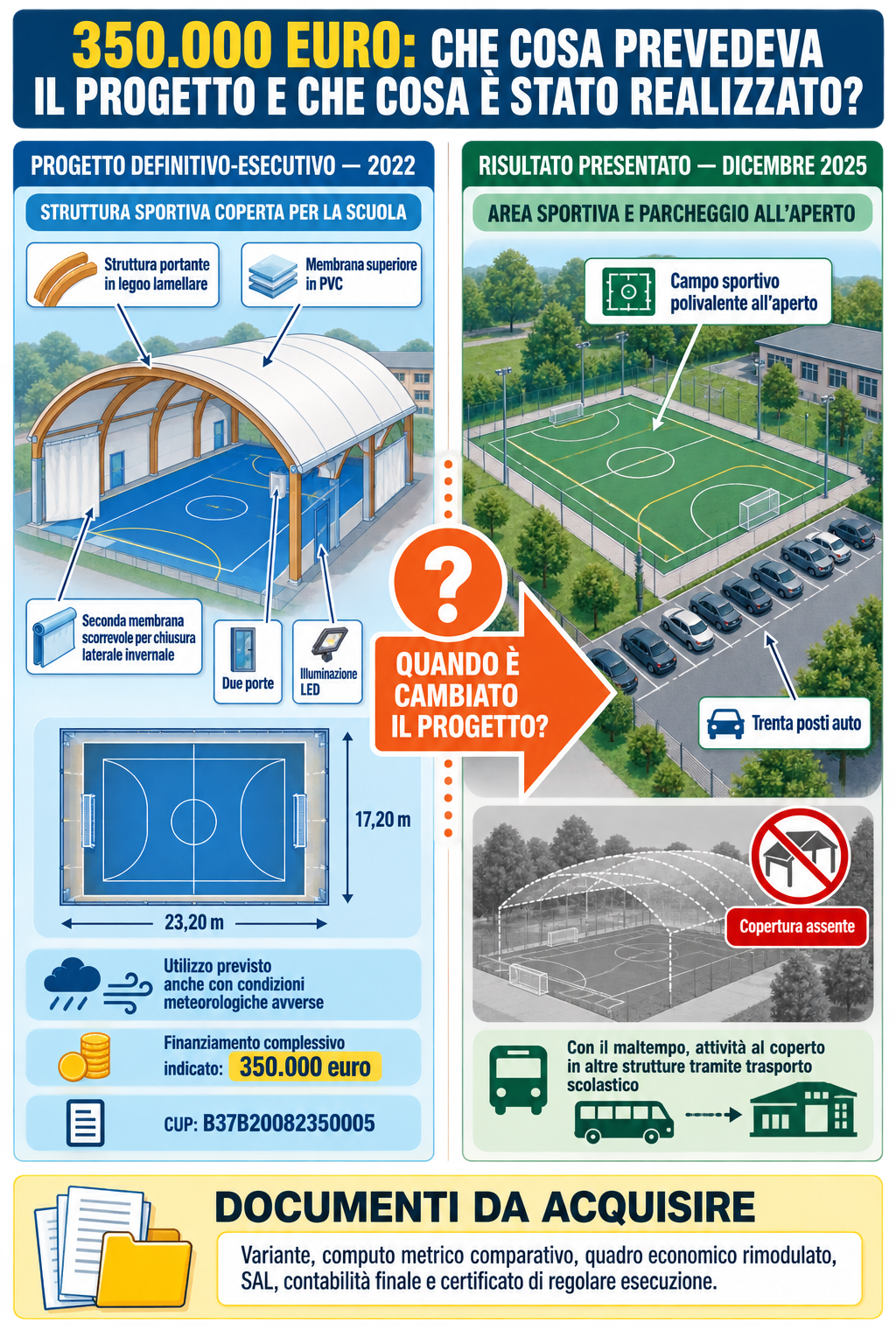
Works did not start at the end of September 2022 as announced. In the 2025 PIAO the Municipality still listed the project as active, with completion expected by 31 March 2026, €350,000 in funding, a value of €295,609.16 shown in the table, and €33,395.36 already paid. The note specified that the project had exited the PNRR funding line and that a €35,000 FOI (Fund for Non-Deferrable Works) grant was "not assigned" — leaving the project's value at €350,000. (The matter of the €35,000 requires its own accounting clarification: other ministerial documents show an entitlement under the same CUP, which needs to be reconstructed before being added.)
In December 2025 the administration presented the result: a sports space "the size of a regulation school gym" and thirty new parking spaces, also for the historic centre. The glue-laminated-timber-and-PVC roof from the 2022 project is not there. The Mayor explains that the available funding did not also cover the roof, and that the area is set up so the roof can be added later through a new grant — with a different solution from the 2022 one: an openable glass structure, topped with a timber roof.
When, and through what measure, did the covered gym planned in the 2022 detailed executive project become an outdoor multi-purpose field with thirty parking spaces, and how were the project's resources redistributed? Without the variant act, the updated economic framework, the comparative bill of quantities and the works accounts, it is not possible to establish the cause — which could be technical or administrative: rising prices, works that emerged during construction, reworkings, different priorities, or additional safety works.
Mayor Ferretti explains that, in the coldest periods, children's physical activity will continue to be guaranteed through school transport to other facilities — including the Centro Turistico Integrato and the gym at the new COC (the former hospital) — "always hoping there are no emergencies". For the roof, the Municipality intends to apply for a new sports or school grant: the statement brings the story right back to the problem recorded by the school after the demolition.
The amounts running through this story must be kept separate, not added together: a municipal preliminary project worth €100,000 in 2013 (never funded), a survey that reportedly estimated at least €120,000 for the roof alone and €300,000-350,000 for the overall damage, a different €700,000 project in 2021 for a larger multi-purpose space, and the €350,000 actually allocated in 2022 to the covered structure that was then not built as such.
To move from doubts to objective checks, administrative documents that the law treats as disclosable are needed:
These are the records that need to explain why a gym that lost its roof in 2012 was left to deteriorate all the way to demolition, and why — when €350,000 finally became available ten years later for a new covered structure on the same site — the result was an open-air sports space. In 2026, fourteen years on, primary-school pupils in Atri can do physical activity on the old Bargiglione site when the weather allows it; when it doesn't, they still have to be taken elsewhere.
This story unfolded over fourteen years, and in Atri the same majority has been in office since 2008. That fact alone does not prove a specific responsibility, nor does it allow every delay or technical choice to be automatically pinned on one administrator — but it does require political continuity to be taken into account when reconstructing the chain of administrative responsibility: the 2012 collapse, the missing temporary protection, the 2013 and 2021 projects, the 2022 covered project and the 2025 open-air field do not belong to entirely separate political seasons. The final question is not only why the covered gym was never given back to the pupils, but which decisions were made, by whom, and when — not a reconstruction along political lines, but a precise check of responsibilities, timing, measures, resources and outcomes.